

Guide to pregnancy hormones
What can hormones tell you about your pregnancy?

Throughout pregnancy, your body becomes flooded with hormones. As pregnancy progresses, you can experience emotional and physical changes.
But what can hormones tell you about how your pregnancy is progressing? If you have just taken our Pregnancy Blood Test or Pregnancy Progress Blood Test, this guide aims to give your results context and further information about each hormone.
- What happens when an egg is fertilised?
- What happens to hormones after an egg is fertilised?
- What can hormones tell me about my pregnancy?
- Changes during each trimester
What happens to hormone levels when an egg is fertilised?
After an egg is fertilised, there’s a finely controlled release of hormones that enables the egg to implant and for the pregnancy to progress normally.
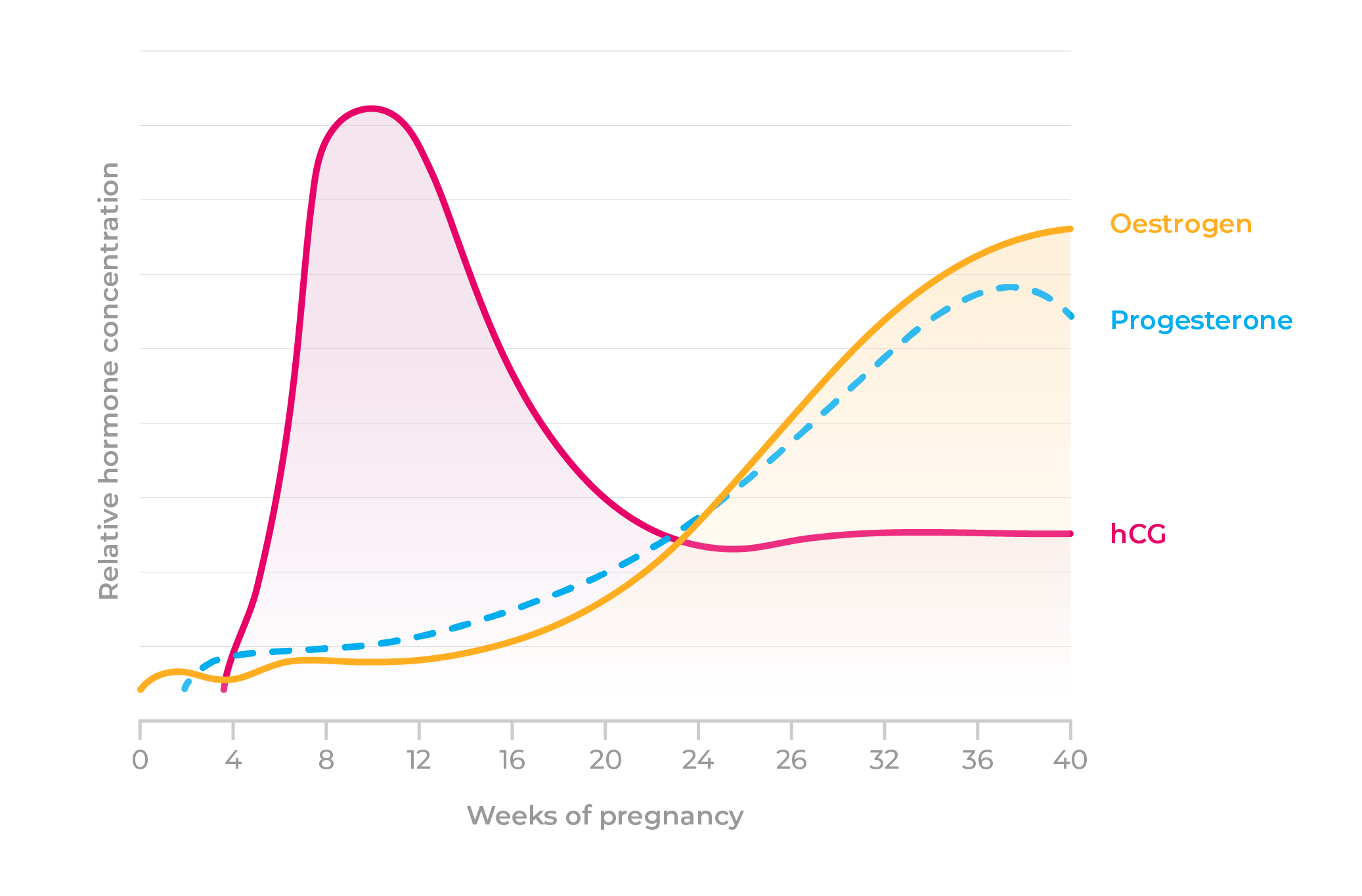
Hormones like progesterone, oestrogen, and human chorionic gonadotrophin (hCG) peak and trough throughout pregnancy, which explains symptoms such as nausea and breast soreness, but they’re also important to show how a pregnancy is progressing.
Beta-hCG (β-hCG)
βhCG is a hormone released by the embryo’s outer layer of cells, which later develop into the placenta. β-hCG levels rise about six to eight days after fertilisation, once the embryo implants into the uterine lining. This is the hormone that pregnancy tests detect as it is one of the earliest hormones to rise. Levels of hCG typically peak between the eighth and tenth week of gestation and then plateau at a lower level for the remainder of the pregnancy.
hCG supports the corpus luteum to release progesterone towards the beginning of pregnancy as well as other important functions. The corpus luteum is a temporary structure that forms in the ovary after an egg is released. It degenerates unless the egg is fertilised.
Progesterone
Progesterone levels steadily increase throughout pregnancy from the first few weeks after fertilisation and peak just before term. Progesterone is produced by the corpus luteum for the first ten weeks, after which the placenta takes over.
Progesterone is responsible for preparing the endometrium (lining of the uterus) before the implantation of the fertilised egg. For the remainder of the pregnancy, progesterone plays a role in the development of the foetus, modulation of the maternal immune system, and growth of maternal breast tissue. Progesterone is also important to help relax the uterus, and to allow it to expand during pregnancy.
Oestrogen
Oestrogen follows a similar trend to progesterone, rising throughout pregnancy and peaking in the third trimester. It too is produced by the corpus luteum initially and is later produced by the placenta. Rising levels of hCG and oestrogen are thought to contribute to symptoms such as nausea and vomiting, commonly known as morning sickness.
Oestrogen controls and stimulates the release of other hormones important in pregnancy. It supports the placenta to grow and promotes breast growth and milk duct development. Oestrogen is also vital to allow the foetus to develop and mature normally.
Prolactin
During pregnancy, prolactin levels increase by up to 20 times. High prolactin levels trigger the body to make milk for breastfeeding. Prolactin levels remain high after labour if the mother continues to breastfeed, otherwise, levels fall quickly.
What can hormones tell me about my pregnancy?
Human chorionic gonadotrophin (hCG)
Levels of hCG typically increase exponentially from day six after fertilisation and peak by the 11th week. Past this point, hCG becomes a less useful way to monitor a pregnancy.
In the first trimester, increasing levels of hCG usually mean that pregnancy is healthy. The upwards trend is more important than the numbers themselves as ranges vary considerably. Typically, levels double roughly every two to three days in early pregnancy.
Low hCG levels may indicate a problem but are not always a sign that something is wrong.
Causes of hCG levels that are lower than expected:
- Miscalculated gestational age — This happens when the estimated stage of pregnancy is wrong. Gestational age is based on the last menstrual period, so miscalculations can occur if someone has irregular periods or is unsure when their last period was.
- Missed miscarriage – If an egg is fertilised and implants but then fails to develop very early on (normally at around week 3-4 from your last menstrual period (LMP)). Then you may notice a very faint HCG line on your pregnancy test, or a small HCG rise on your blood test, which slowly fades over a few days and disappears. This is commonly a missed miscarriage, and indicated either there was an implantation issue, or there could have been a genetic issue with that fertilised egg, which stopped it from developing. This is very common and is thought to occur in ~5% of pregnancies.
- Blighted ovum – A blighted ovum (also called an anembryonic pregnancy) is a type of very early miscarriage. In this situation, the fertilised egg implants in the uterus, but the embryo either never develops or stops developing very early. It is usually detected around 6 weeks on an ultrasound scan, where the sonographer can see a gestational sac but no developing embryo. This is most often caused by chromosomal abnormalities in the embryo, though other factors such as implantation problems can also play a role.
- Ectopic pregnancy — In the UK, around one in 90 pregnancies is ectopic. This is where the embryo attaches anywhere outside of the uterus, usually in the fallopian tubes. Unfortunately, an ectopic pregnancy can be dangerous and cannot progress. Levels of hCG tend to be lower with an ectopic pregnancy and rise more slowly than in a normal pregnancy. Common symptoms of an ectopic include bleeding after or during sex, pain in the pelvis early in the first trimester, and HCG levels growing slower than 50% every 1-2 days. Some ectopic pregnancies may not have any symptoms, and the pain can only develop once the ectopic ruptures. If you have severe pain in your pelvis during your first trimester, which causes you to bend over, or have to lie down, then please see your doctor urgently.
- Miscarriage — A low hCG level may signal that a miscarriage has happened or is about to happen. A miscarriage is the loss of a pregnancy during the first 23 weeks and 6 days, and they are very common, affecting about one in eight pregnancies. For most women, a miscarriage is a one-off event, and they can go on to have a successful pregnancy in the future.
Causes of hCG levels that are higher than expected:
- Multiple pregnancy — High hCG levels may be raised due to twins or triplets. A multiple pregnancy is more common after in vitro fertilisation (IVF).
- Miscalculated gestational age — If the presumed date of the last menstrual period is wrong, the pregnancy could be further along than expected and hCG levels may be unexpectedly raised.
- Molar pregnancy — Molar pregnancies are where the baby and placenta do not develop as they should after fertilisation. Molar pregnancies are very rare and happen by chance. They are often identified when someone has a very high HCG level on blood test, and the ultrasound shows an abnormal boggy uterus. They often require specialist input from a gynaecologist, and require HCG monitoring, and on some occasions medications or surgery.
Progesterone
Abnormal progesterone levels during pregnancy are uncommon. However, if levels are significantly lower than expected, it may mean the uterus is not able to carry the baby to term.
Bear in mind that a single blood test in isolation is not always reliable because progesterone levels fluctuate over 24 hours. So, taking the average of several results is a better way to track progesterone levels.
Progesterone levels that are lower than expected may indicate:
- Ectopic pregnancy — This is if a fertilised egg implants anywhere other than the uterus. It can result in a positive pregnancy test, but the pregnancy cannot progress. Progesterone and hCG levels are lower than usual in ectopic pregnancies.
- Miscarriage — Women who miscarry often have low progesterone levels, although it’s unclear whether low progesterone causes the miscarriage or occurs because the pregnancy is not developing normally. Research shows that progesterone supplements do not help in all cases, but they can improve outcomes for women who have early pregnancy bleeding and have had one or more previous miscarriages.
Progesterone levels that are higher than expected may indicate:
- Multiple pregnancy — When more than one baby is growing, it can cause hormone levels to increase. A multiple pregnancy usually requires additional monitoring throughout pregnancy as the risk of complications is higher than a single birth.
- Molar pregnancy — As well as causing raised hCG levels, molar pregnancies can also cause progesterone levels to surge. Finding out about a molar pregnancy can be very difficult, and a doctor or midwife can direct you to the advice and support that’s available.
Oestrogen
Though progesterone is considered the dominant hormone during pregnancy, oestrogen is just as vital for a healthy pregnancy.
Oestrogen plays a role in regulating progesterone release, and a significant drop could signify a miscarriage. However, there is not usually a need to check oestrogen during pregnancy as it may cause unnecessary worry.
Changes during each trimester
First trimester changes (0–12 weeks)
A lot of the symptoms in the first trimester are due to a surge in hCG levels. These symptoms can come and go during pregnancy, which is completely normal. These symptoms include:
- Headaches
- Irritability
- Fatigue
- Increased urination
- Insomnia
- Breast enlargement
- Morning sickness
Second trimester changes (13–27 weeks)
In the second trimester, oestrogen and progesterone levels increase and can cause:
- Mood swings
- Nasal congestion and headaches
- Swollen hands and feet
- Hyperpigmentation (darkening) of the nipples and along the midline of the belly
- Breast enlargement
- Aching back, pelvis, and hips
Third trimester changes (28 weeks and onwards)
Oestrogen and progesterone reach their peak during the third trimester. Symptoms during this period of pregnancy include:
- Indigestion, heartburn, and constipation
- Aches and pains in the back, pelvis, and hips
- Breast growth (the breasts may start to leak colostrum)
- Puffiness
- Varicose veins
Summary
Pregnancy is a unique and individual experience. As such, great care should be taken when interpreting results — something that may appear abnormal may be harmless, and vice versa. Discuss your results with a doctor if you’re concerned.
There is no right or wrong way to feel about being pregnant, but it’s common to feel vulnerable, anxious, or overwhelmed. If this is the case, speak to your doctor or midwife who can explore these feelings with you and hopefully reassure you.
If you have lost a pregnancy, The Miscarriage Association and Tommy’s are UK-based charities that offers information and emotional support to help you through a difficult time.
References
- NHS. 2021. Doing a pregnancy test. [online]. [Accessed 17 March 2026].
- Cole L. A. 2010. Biological functions of hCG and hCG-related molecules. Reproductive biology and endocrinology : RB&E, 8, 102. https://doi.org/10.1186/1477-7827-8-102
- Kumar, P., & Magon, N. 2012. Hormones in pregnancy. Nigerian medical journal : journal of the Nigeria Medical Association, 53(4), 179–183. https://doi.org/10.4103/0300-1652.107549
Related tests
Need early and reliable confirmation of pregnancy? This blood test measures human chorionic gonadotropin (hCG), the hormone produced during pregnancy, providing accurate results even before a missed period
- Results estimated in 2 working days
- 1 biomarkers
Finger-prick or Venous collection
Select testWant reassurance about your early pregnancy? This test measures beta hCG and progesterone, two key hormones that help confirm pregnancy viability and monitor early development
- Results estimated in 2 working days
- 2 biomarkers
Venous collection
Select test