Understanding blood tests: your results explained
Learn how to read blood test results, interpret your reference ranges, and know when to seek medical advice.

Blood tests are one of the most useful tools in modern healthcare. They can help identify health conditions, monitor ongoing treatment, or simply offer reassurance about how your body is functioning beneath the surface.
You can read more about what a blood test can detect in our blog.
But what about once your results arrive? The meaning behind the numbers isn’t always immediately obvious.
This guide explains how to read your results, what reference ranges actually mean, and why results don’t always tell the full story on their own.
We’ll cover:
- Why blood test results can be difficult to interpret
- How are blood test results reported?
- What is a reference range and how is it set?
- Can I compare results between different laboratories?
- Some of my blood test results are outside the reference range – should I be worried?
- What can influence your blood test results?
- What should I do if I get an unexpected result?
Why blood test results can be difficult to interpret
Blood test results are given either as a scale of where they fall within a normal range (vitamins, minerals, or hormones) or whether something has been detected or not (e.g. a virus). This often looks like a list of numbers and reference ranges.
Laboratories usually report results electronically.
The report is likely to include:
- Biomarker names (or codes)
- Date of measurements
- Reference ranges
- Units used
- Any notes from the laboratory staff
While this format is clinically useful, if you haven’t studied medicine, it could be difficult to interpret. And what’s often missing (especially in results from non-specialist providers) is context.
Some GPs may not have the time to take you through your test results, and you may not be told any values, only whether they are normal or abnormal. However, if you are interested in knowing more, you have the right to ask your GP for a copy of your results.
How are blood test results reported at Medichecks?
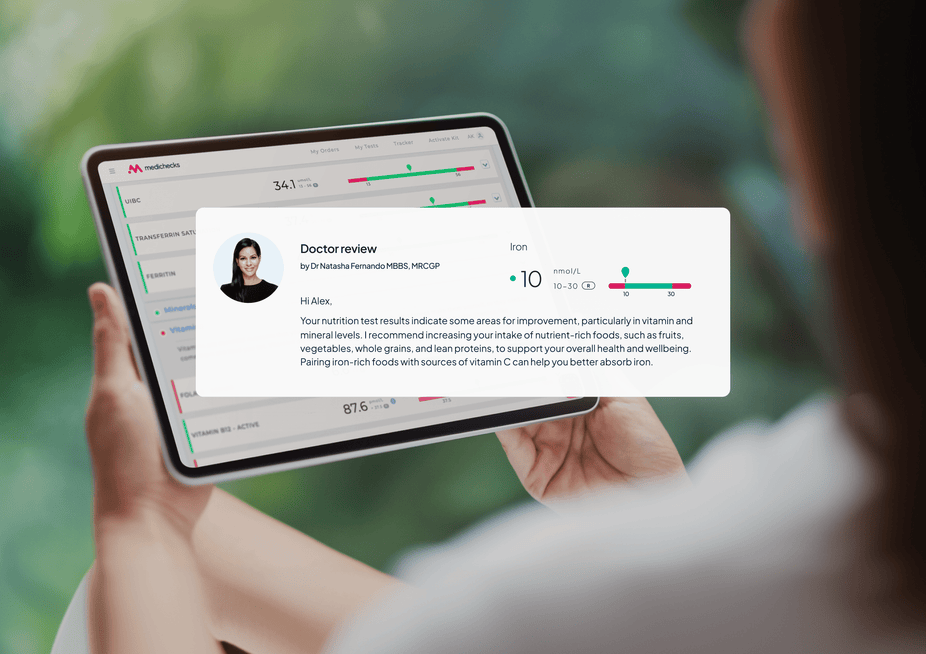
At Medichecks, we analyse the data and upload the results to your online account - MyMedichecks. You'll find a simple traffic light system used to highlight your results - red for abnormal results and green for results that are normal.
You'll also see:
- Detailed explanations of each biomarker
- What high and low results mean
- Steps you can take to bring your result into the normal range
- If follow-ups are needed of not
This allows you to see where your results sit within the normal range.
What is a reference range and how is it set?
To understand blood test results, it helps to start with the reference range.
A reference range is based on results from a large group of generally healthy people. Typically, about 95% of healthy individuals fall within this range [1,2].
This means 2.5% of that population will be above the normal range, and 2.5% will be below. At the edges of the normal range, there are areas of overlap where healthy individuals might have results outside the normal range, and unwell individuals could have them inside the normal range [2].
Can I compare results between different laboratories?
If you want to compare results between different laboratories, it is best not to compare results directly. Not all blood tests are presented in the same way. Laboratories use varying machines and reference ranges.
Different laboratories may use:
- Different analysers and testing methods
- Different reference ranges
- Different reporting formats
This means the same test can look slightly different depending on where it was done.
If you’ve had a test elsewhere and are trying to make sense of it, this variation can make interpretation feel more difficult than expected.
In most cases, it’s better not to compare raw numbers directly between laboratories.
Instead, focus on:
- Where your result sits within that lab’s reference range
- Whether results are consistently high or low over time
- Whether multiple markers suggest a pattern
You can read more about the accredited labs Medichecks partner with in our blog.
Some of my blood test results are outside the reference range – should I be worried?
A borderline or out-of-range result can feel worrying at first glance, but it is not always a sign that something is wrong. Blood test results can be abnormal for many reasons.
Results can be influenced by:
- Temporary changes in lifestyle, such as intense exercise
- Recent illness or recovery
- Medications or supplements
- Natural variation between individuals
In many cases, doctors will look at the result alongside symptoms, medical history, and other markers before drawing conclusions. That’s why with a Medichecks blood test you get a personalised doctors note alongside your results.
What can influence your blood test results?
A few things can cause skewed blood test results. Laboratories are aware of these factors and have a great deal of experience dealing with many of these interferences.
Some can be planned for, such as whether you fast before collecting your sample, for example. While others may only become apparent when investigating an unexplained result.
Before you take your blood test, you will be told whether there are any special instructions (such as fasting) that you should follow [3].
What can influence your test results:
- The time of day your sample was taken
- Whether you have eaten, especially for glucose tests where you should fast
- How hydrated you are
- Whether you are taking supplements or medications
Top 10 factors that can affect your blood test results
We are aware that there are factors that can affect blood test results, but what do they include?
1. Fasting
Some tests can be influenced if you have just eaten [4]. Certain tests for diabetes, like insulin and glucose, will be affected by a recent meal [5,6].
If a test requires you to fast, you will be told, or it will state in the instructions. You will usually be asked to fast for eight hours or overnight.
2. Hydration
Hydration is key in the working of vital organs. Your level of hydration can affect certain markers when testing.
These including:
- Kidney health
- Red blood cells
- Liver markers
Keep yourself well hydrated (unless stated in the instructions not to) for the best chance of reliable results [7].
3. Exercise
Strenuous exercise can cause certain liver and muscle enzymes to be released into your bloodstream [8] and testosterone levels to be temporarily high or low.
If you want a true picture of your liver and hormone health, it is best to wait a few days after exercise to take a blood test.
4. Supplements
Taking vitamin or mineral supplements will almost always cause your blood levels of that vitamin or mineral to rise unless you have a problem absorbing nutrients in food (such as coeliac disease).
Biotin (vitamin B7) is known to interfere with some laboratory tests (including tests for thyroid-related conditions) as it is used in the testing process itself [9,10]. If your test is affected by biotin, you’ll be advised to stop taking it before your test.
5. Medications
Numerous drugs and medications can influence your blood test results.
It’s always best to let your doctor or testing company know what medications (prescribed or otherwise) you are taking so that they can put any unusual results into context.
6. Age
Your age can influence things like your hormone levels, and the laboratory will have different reference ranges for some tests according to the age range you fall into.
For women, knowing where you are in your menstrual cycle or whether you are post-menopausal may also affect your reference ranges for hormone levels.
7. Time of day
Some hormones are very dependent on the time of day – both cortisol and testosterone levels are highest in the morning and will decline over the rest of the day.
For this reason, it’s recommended for both these tests to be taken when waking, usually, around 8 am-9 am.
8. Diet
Some tests require you to have eaten specific foods to be able to give you an accurate result.
This is particularly true of tests for coeliac disease, which are looking for an immune response to gluten – for the test to work properly, you need to have eaten gluten for at least six weeks prior.
9. Illness
Being ill or having just been ill can affect your blood test results.
Taking a blood test while you’re unwell might show:
- Temporarily raised or lowered white blood cells
- Elevated inflammatory or liver markers
- Abnormal thyroid hormone levels (as your body adjusts your metabolism to help you conserve energy and recover)
It is best to wait a few weeks (six weeks for a thyroid test) after any acute illness before having a blood test.
10. Hormone gels
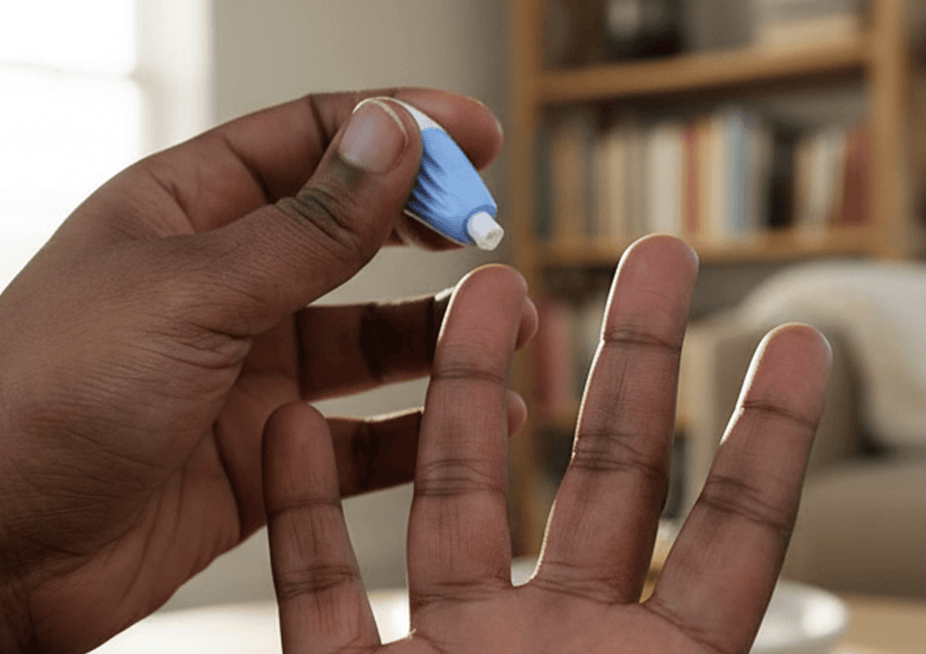
Hormone gels can be absorbed into the skin as you apply the gel. If you are taking a hormone test with a finger-prick sample, it is common to see elevated results if you take the sample from the same finger you use to apply the gel (or hormone pessary). This is because the sample can become contaminated with the hormones absorbed in your finger.
What should I do if I get an unexpected result?
If a result looks unusual, your GP will discuss this with you. They may wish to repeat the test – sometimes, other factors may lead to a falsely abnormal result. They may also perform a physical examination or order additional tests.
If your Medichecks blood test result is abnormal, our team of expert doctors will pick up on this and advise you on what to do next.
For help choosing a blood test, read our top six blood tests to buy, or use our test finder.
References
- British Liver Trust. Understanding blood test reference ranges. 2025 [cited 19 May 2026]. Available: https://britishlivertrust.org.uk/information-and-support/tests-diagnosis-and-screening/reference-ranges/
- Bates I, Mitchell L. Practical Haematology. Elsevier Ltd.; 2012. Available: https://books.google.com/books/about/_.html?id=4bYfEQAAQBAJ
- NHS UK. Blood tests. In: Blood testing advice [Internet]. 2018 [cited 20 May 2026]. Available: https://www.nhs.uk/tests-and-treatments/blood-tests/
- NHS Foundation Trust. Fasting for your blood test. In: Information for pateints from the Clinical Biochemistry Department [Internet]. 2025 [cited 20 May 2026]. Available: https://leaflets.ekhuft.nhs.uk/fasting-for-your-blood-test/html/
- LanTests Online UK. Glucose test preparation. In: Glucose Tests [Internet]. 2025 [cited 20 May 2026]. Available: https://labtestsonline.org.uk/tests/glucose-tests
- LabTests Online UK. Insulin test preparation. In: Insulin Tests [Internet]. 2025 [cited 20 May 2026]. Available: https://labtestsonline.org.uk/tests/insulin
- Ritchie RF, Ledue TB, Craig WY. Patient hydration: a major source of laboratory uncertainty. Clin Chem Lab Med. 2007;45: 158–166. doi:10.1515/CCLM.2007.052
- Pettersson J, Hindorf U, Persson P, Bengtsson T, Malmqvist U, Werkström V, et al. Muscular exercise can cause highly pathological liver function tests in healthy men. Br J Clin Pharmacol. 2008;65: 253–259. doi:10.1111/j.1365-2125.2007.03001.x
- Sathyanarayana Rao TS, Christopher R, Andrade C. Biotin supplements and laboratory test results in neuropsychiatric practice and research. Indian J Psychiatry. 2017;59: 405–406. doi:10.4103/psychiatry.IndianJPsychiatry_454_17
- Barbesino G. Misdiagnosis of Graves’ Disease with Apparent Severe Hyperthyroidism in a Patient Taking Biotin Megadoses. Thyroid. 2016;26: 860–863. doi:10.1089/thy.2015.0664
Related Help & Advice